Sunday, September 1, 2013

McMaster University

McMaster University (commonly referred to as McMaster or Mac) is a public research university whose main campus is located in Hamilton,Ontario, Canada. The main campus is located on 121 hectares (300 acres) of land in the residential neighbourhood of Westdale, adjacent to Hamilton's Royal Botanical Gardens. The university operates six academic faculties: the DeGroote School of Business, Engineering, Health Sciences, Humanities, Social Science, and Science. It is a member of the U15, a group of research-intensive universities in Canada.
The university bears the name of Honourable William McMaster, a prominent Canadian Senator and banker who bequeathed C$900,000 to the founding of the university. McMaster University was incorporated under the terms of an act of the Legislative Assembly of Ontario in 1887, merging the Toronto Baptist College with Woodstock College. It opened in Toronto in 1890. Inadequate facilities and the gift of land in Hamilton prompted the institution to relocate in 1930. McMaster was controlled by the Baptist Convention of Ontario and Quebec until it became a privately chartered, publicly funded non-denominational institution in 1957.
The university is co-educational, and has over 24,500 undergraduate and nearly 4,000 post-graduate students. Alumni and former students of the university can be found all across Canada and in 140 countries around the world. Notable alumni include government officials, academics, business leaders and two Nobel laureates. The university ranked 88th in the 2012-2013 Times Higher Education World University Rankings, 92nd in the 2012 Academic Ranking of World Universities, and 152nd in the 2012 QS World University Rankings.[12] The McMaster athletic teams are known as the Marauders, and are members of the Canadian Interuniversity Sport.

University of Ottawa

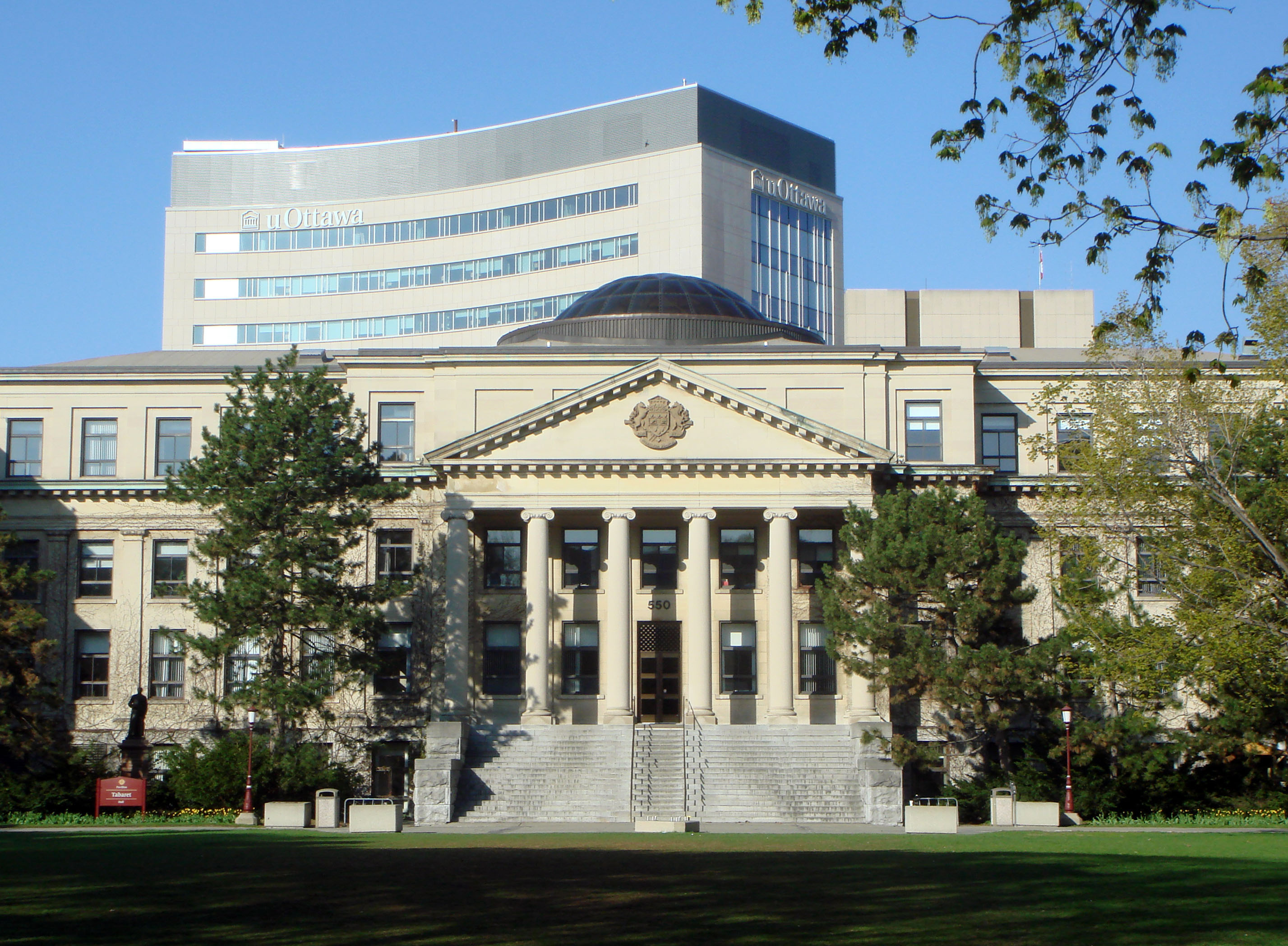
The University of Ottawa (uOttawa or U of O) (French: Université d'Ottawa) is a bilingual public research university in Ottawa, Ontario, Canada. The main campus is located on 42.5 hectares (105 acres) in the residential neighbourhood of Sandy Hill, adjacent to Ottawa's Rideau Canal. The University offers a wide variety of academic programs, administered by ten faculties. It is a member of the U15, a group of research-intensive universities in Canada.
The University of Ottawa was first established as the College of Bytown in 1848 by the first bishop of the Roman Catholic Archdiocese of OttawaJoseph-Bruno Guigues (French priest). Placed under the direction of the Oblates of Mary Immaculate, it was renamed the College of Ottawa in 1861 and received university status five years later through royal charter. On 5 February 1889, the University was granted a pontifical charter by Pope Leo XIII, elevating the institution to a pontifical university.

Université du Québec

The Université du Québec à Montréal (UQAM) is a comprehensive public university based in Montreal, Quebec, Canada. It is a French-language university and is the largest constituent element of the Université du Québec (UQ), a public university system.
UQAM was founded on April 9, 1969 by the government of Quebec, through the merger of the École des Beaux-Arts de Montréal, a fine arts school; the Collège Sainte-Marie, a classical college; and a number of smaller schools. Although part of the UQ network, UQAM possesses a relative independence which allows it to print its own diplomas and choose its rector.
In 2011, UQAM had a student population of 41,325 in six faculties (Arts, Education, Communication, Political Science and Law, Science and Social science) and one school (Management). It offers Bachelors, Masters, and Doctoral degrees. It is one of Montreal's two French-language universities, along with the Université de Montréal, and only 1% of its student population is Anglophone

University of Victoria

The University of Victoria, often referred to as UVic, a research intensive university located inSaanich and Oak Bay, about 5 mi (8 km) northeast of downtownVictoria, British Columbia. The University's annual enrollment is about 20,000 students. UVic's campus is known for its innovative architecture, beautiful gardens and mild climate. The university was closely affiliated with and established by McGill University, which is also credited with the beginnings of the University of British Columbia.
The University attracts many students in part because of its size, its picturesque location, and its Cooperative Education, Earth & Ocean Sciences, Engineering, and Law programs. The University is the nation's lead institution in the VENUS and NEPTUNE deep-water seafloor observatory projects.
The Victoria Vikes (more commonly known as the UVic Vikes or simply the Vikes) represent the University in theCanadian Interuniversity Sport(CIS) community in a number of competitive sports, as well as through a variety of intercollegiate leagues. The Vikes have especially long and eminent ties to competitive rowing and basketball.
The University is ranked among the top 200 universities in the world and ninth place in Canada in the 2012 Times Higher Education World University Rankings and first place in Canada in the Times Higher Education’s 100-under-50 rankings. UVic was the top-ranked university in Canada without an autonomous medical school in the THE rankings. The University has also been home to more than 40 faculty members who are Fellows of the Royal Society of Canada since the University of Victoria's founding.

University of Calgary

The University of Calgary (U of C or UCalgary) is a publicresearch university located in Calgary, Alberta, Canada. Founded in 1966 (after operating as the Calgary branch of the University of Alberta since 1945) the U of C is composed of 14 faculties and more than 85 research institutes and centres.
More than 25,000 undergraduate and 5,500 graduate students are currently enrolled. The U of C has graduated over 145,000 alumni, including the current Prime Minister of Canada, Stephen Harper, and Canadian astronaut Robert Thirsk.
The University of Calgary is one of Canada’s top research universities (based on the number of Canada Research Chairs) and is a member of theU15 (the 15 most research-intensive universities in Canada).
The U of C is the birthplace of a number of important inventions, including theneurochip.[5] The university's sponsored research revenue of $352 million, with total revenues exceeding $1.1 billion, is one of the highest in the country. Being in Calgary, with Canada's highest concentration of engineers and geoscientists, the Faculty of Science, Department ofGeosciences and the Schulich School of Engineering maintain ties to the petroleum and geoscience industry.[citation needed]
The main campus is located in the north-west quadrant of Calgary, near theBow River, and covers more than 200 hectares or 494.2 acre.

Queen's University

 Queen's University at Kingston(commonly shortened to Queen's University or Queen's) is a public research university located in Kingston, Ontario, Canada. Founded on 16 October 1841, the university predated the founding of Canada by 26 years.Queen's holds more than 1,400 hectares (3,500 acres) of land throughout Ontario and owns Herstmonceux Castle in East Sussex, England. Queen's is organized into ten undergraduate, graduate and professional faculties and schools.
The Church of Scotland established Queen's College in 1841 with a royal charter from Queen Victoria. The first classes, intended to prepare students for the ministry, were held 7 March 1842 with 13 students and two professors. Queen's was the first university west of the maritime provinces to admit women, and to form a student government. In 1883, a women's college for medical education affiliated with Queen's University. In 1888, Queen's University began offering extension courses, becoming the first Canadian university to do so. In 1912, Queen's secularized and changed to its present legal name.
Queen's is a co-educational university, with more than 23,000 students, and with over 131,000 living alumni worldwide. Notable alumni include government officials, academics, business leaders and 56 Rhodes Scholars.The university ranked 175th in the 2012 QS World University Rankings,201-225th in the 2012-2013 Times Higher Education World University Rankings,and 201-300 in the 2012 Academic Ranking of World Universities.Queen's varsity teams, known as the Golden Gaels, compete in the Ontario University Athletics conference of the Canadian Interuniversity Sport.

University of Waterloo

University of Waterloo (commonly referred as Waterloo or UW) is a public research university whose main campus is located in Waterloo, Ontario,Canada. The main campus is located on 404 hectares (1,000 acres) of land in Uptown Waterloo, adjacent to Waterloo Park. The university offers a wide variety of academic programs, which is administered by six faculties and ten faculty-based schools. The university also operates four satellite campuses and four affiliated university colleges.[3] Waterloo is a member of the U15, a group of research-intensive universities in Canada.[8]
The university traces its origins to 1 July 1957 as the Waterloo College Associate Faculties, a semi-autonomous entity of Waterloo College (which later evolved into the present-day Wilfrid Laurier University). The entity had formally separated from Waterloo College in 1959, and was incorporated as a university.[1] The university was established in order to fill the need of a program to train engineers and technicians for Canada’s growing postwar economy. Since then, the university had greatly expanded, adding a faculty of arts in 1960, and the College of Optometry of Ontario moving fromToronto in 1967.[1]
The university is co-educational, and has nearly 26,000 undergraduate and over 4,000 post-graduate students. Alumni and former students of the university can be found all across Canada and in 141 countries around the world.[3] The university ranked 151-200th in the 2012 Academic Ranking of World Universities,[9] 191st in the 2012 QS World University Rankings,[10] and 226-250th in the 2012-2013 Times Higher Education World University Rankings.[11] Waterloo's varsity teams, known as the Waterloo Warriors compete in the Ontario University Athletics conference of the Canadian Interuniversity Sport

University of Alberta

The University of Alberta (also known as U of A and UAlberta) is a public research university located in Edmonton, Alberta, Canada. It was founded in 1908 by Alexander Cameron Rutherford,[6] the first premier of Alberta, and Henry Marshall Tory (McGill University alumni), its first president. Its enabling legislation is the Post-secondary Learning Act.
The university comprises four campuses in Edmonton, the Augustana Campus in Camrose, and a staff centre in downtown Calgary. The original north campus consists of 150 buildings covering 50 city blocks on the south rim of the North Saskatchewan River valley, directly across from downtown Edmonton. More than 39,000 students from across Canada and 152 other countries participate in nearly 400 programs in 18 faculties.
The University of Alberta is a major economic driver in Alberta. The university’s impact on the Alberta economy is an estimated $12.3 billion annually, or five per cent of the province’s gross domestic product.[9] With more than 15,000 employees, the university is Alberta's fourth-largest employer.[10]
The University of Alberta has been recognized by the Academic Ranking of World Universities, the QS World University Rankings and the Times Higher Education World University Rankings as one of the top five universities in Canada and one of the top 100 universities worldwide. It has graduated nearly 250,000 alumni, including Governor General Roland Michener, Prime Minister Joe Clark, Chief Justice of Canada Beverley McLachlin, Premier of Alberta Peter Lougheed and Nobel laureate Richard E. Taylor.

McGill University

McGill University is a public research university located in Montreal, Quebec, Canada. Founded in 1821 during the British colonial era, the university bears the name of James McGill, a prominent Montreal merchant from Glasgow, Scotland and alumnus of Glasgow University, whose bequest formed the beginning of the university. Several colleges and universities were established by McGill, including the University of British Columbia, which was known as the McGill University College of British Columbia until 1915, the University of Victoria, an affiliated junior college of McGill until 1916, andDawson College which began in 1945 as a satellite campus of McGill to absorb the anticipated influx of students after World War II. In addition, McGill medical graduate and former professor, William Osler, was among the four founders and early faculty members of the Johns Hopkins School of Medicine. Both founders of the University of Alberta, Premier Alexander Cameron Rutherford and Henry Marshall Tory, were also McGill alumni.
McGill University has almost 215,000 living alumni worldwide. Notable alumni include nine Nobel Laureates (overall, twelve Nobel laureates are affiliated with the university), one hundred and thirty-four Rhodes Scholars (more than any other Canadian university),three astronauts, twoCanadian prime ministers, twelve justices of the Canadian Supreme Court,four foreign leaders, twenty-eight foreign ambassadors, nine Academy Award winners, three Pulitzer Prize winners, and twenty-eight Olympic medalists. In addition, McGill alumni were instrumental in inventing or initially organizing football, basketball, and ice hockey. The McGill-Queen's University Press, also founded by a McGill alumnus, "is generally recognized as Canada's leading academic publisher. McGill is one of two member-universities of the Association of American Universities situated outside theUnited States.
As of the 2012-2013 school year, McGill was ranked 1st in Canada among all its major/research universities offering medical and doctoral degrees in the Maclean's 22nd annual rankings, maintaining this position for the eighth consecutive year. Internationally, McGill ranked 18th in the world and 1st in Canada in the 2012 QS World University Rankings and the 2012-2013 U.S. News & World Report's Top 400 Universities, maintaining its ranking among the top 20 universities globally, and as Canada's top university, for the ninth consecutive year. Bloomberg BusinessWeek's 2012 Business Schools Ranking ranked McGill's Desautels Faculty of Management 10th in the world among non-US business schools, referring to McGill University as "the #1 university in Canada and among the top 20 worldwide. McGill was ranked 34th in the world and 3rd in Canada by the Times Higher Education World University Rankings.In the 2011 Emerging/Trendence Global Employability Ranking, McGill was ranked 19th in the world, and 1st in Canada, for popularity among major employers.
With 21 faculties and professional schools, McGill offers degrees and diplomas in over 300 fields of study, including medicine and law. Although the language of instruction is English, students have the right to submit any graded work in English or in French, except when learning a particular language is an objective of the course. Approximately 36,000 students attend McGill, with international students comprising one-fifth of the student population.
In 2012, Travel + Leisure rated McGill's campus as one of the 17 most beautiful university campuses in the world.The main campus is set upon 32hectares (79 acres) at the foot of Mount Royal in Downtown Montreal, covering much of the Golden Square Mile. A second campus, the Macdonald Campus, is situated on 6.5 square kilometres (1,600 acres) of fields and forested land in Sainte-Anne-de-Bellevue, 30 km (19 mi) west of the downtown campus.

York University

York University (French: Université York) is a public research university in Toronto, Ontario, Canada. It is Ontario's second-largest graduate schooland Canada's third-largest university.
York University has approximately 55,000 students, 7,000 faculty and staff, and 250,000 alumni worldwide. It has eleven faculties, namely the Faculty of Liberal Arts & Professional Studies, Faculty of Science, Schulich School of Business, Osgoode Hall Law School, Glendon College, Faculty of Education, Faculty of Fine Arts, Faculty of Health, Faculty of Environmental Studies, Lassonde School of Engineering, Faculty of Graduate Studies, and 28 research centres.
York University participates in the Canadian Space Program. The Faculties of Science and Engineering are Canada's primary research facility into Martian exploration, and have designed several space research instruments and applications currently used by NASA.York has pioneered some of the first PhD programs in Canada, in various fields including women's studies.The school of social work is recognized as having one of the most socially responsive programs in the country.York University's business school and law school have continuously been ranked among the top schools in Canada and the world.

University of British Columbia

The University of British Columbia (commonly referred to as UBC) is a Canadian public research university with campuses and facilities in British Columbia, Canada. It is the oldest institution of higher learning in the province of British Columbia and has the largest enrollment with over 57,000 students at its Vancouver and Okanagan campuses combined.[8] The university was incorporated in Vancouver in 1908 as the McGill University College of British Columbia, and became the independent University of British Columbia in 1915. [9] UBC's main 4.02 km2 (993-acre) Vancouvercampus is located within the University Endowment Lands, about 10 km (6.2 mi) from Downtown Vancouver.[10] The 2.09 km2 (516-acre) Kelowna campus, open since 2005, is located in the Okanagan Valley.
As of the 2012-2013 school year, UBC was ranked 2nd in Canada among major research universities in the Maclean's 22nd annual rankings.[11] The university was also ranked 30th worldwide (and 2nd in Canada) in the 2012–2013 Times Higher Education World University Rankings, 40th worldwide (and 2nd in Canada) in the 2013 Academic Ranking of World Universities, and 8th overall (and 2nd among Canadian universities) inNewsweek's ranking of top universities outside of the United States.[12][13] In 2011, UBC reported the highest entrance requirements for undergraduate admission in Canada.[14] UBC faculty, alumni, and researchers have won seven Nobel Prizes, 67 Rhodes Scholarships, 64 Olympic medals, and alumni include two Canadian prime ministers.[10][15]
UBC is consistently included among the top three research universities in Canada,[16] and among the top research universities in the world, both in terms of quality and quantity of research.[17] In fiscal year 2012, UBC reported $519 million per year in research funding, involving over 16,000 faculty and staff.[18] A founding member of the U15, UBC attracts research funding from government, non-profit organizations and industry through approximately 8,000 projects.[17] The university encompasses twenty-six faculties and schools at its Vancouver campus, eight faculties and schools at its Okanagan campus and is affiliated with several research institutes, centres, organizations and hospitals. [19]
UBC is a non-sectarian and coeducational institution, with more than 275,000 living alumni in 120 countries.[8] The university is a member ofUniversitas 21, the Association of Universities and Colleges of Canada, the Association of Southeast Asian Institutions of Higher Learning, theInternational Association of Universities, the U15 and the only Canadian member of the Association of Pacific Rim Universities. The university's varsity teams, known as the Thunderbirds, compete in the Canada West Universities Athletic Association of the Canadian Interuniversity Sport.

University of Toronto

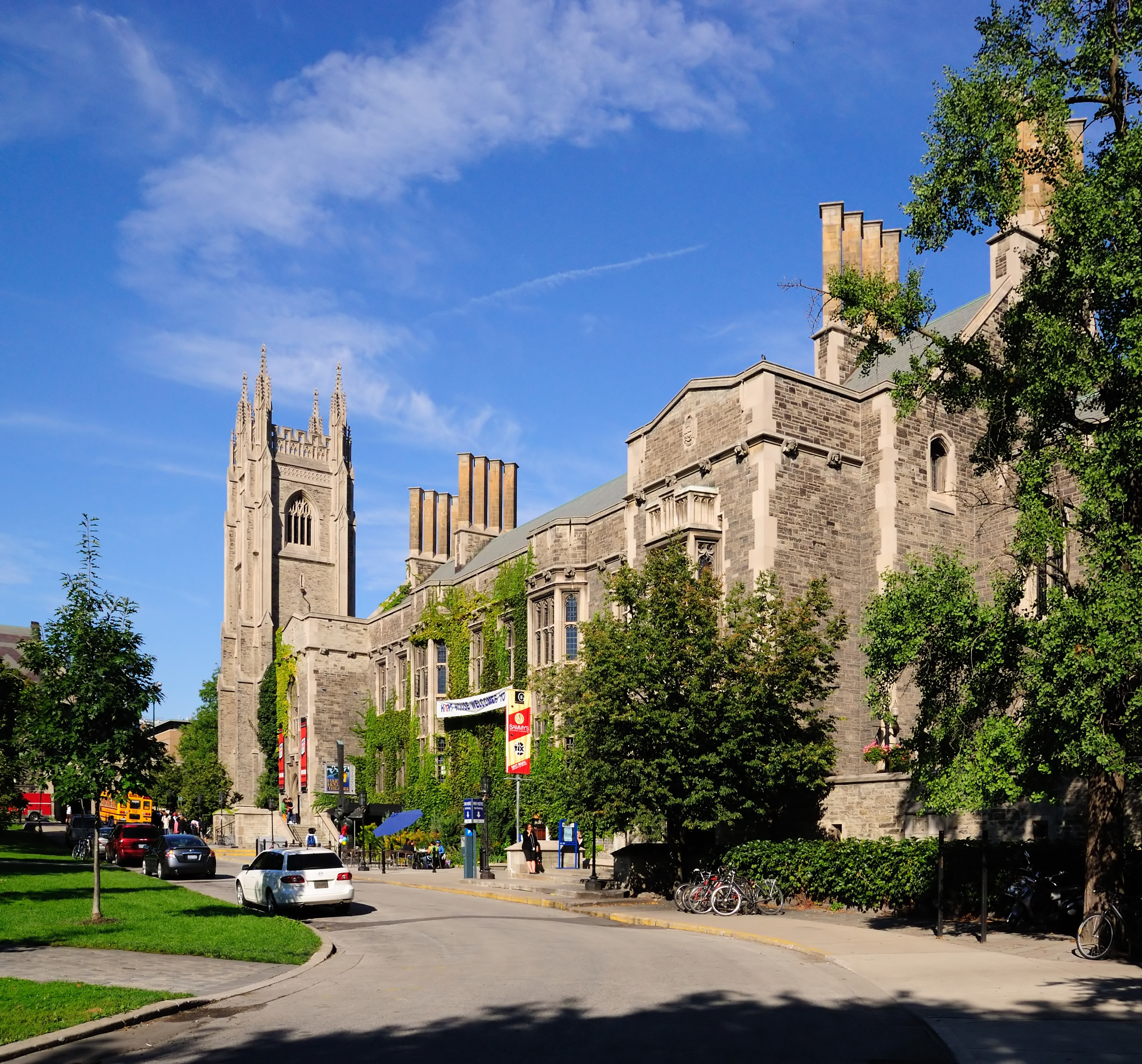
 The University of Toronto (U of T, UToronto, or Toronto) is a public research university in Toronto, Ontario, Canada, situated on the grounds that surround Queen's Park. It was founded by royal charter in 1827 as King's College, the first institution of higher learning in Upper Canada. Originally controlled by the Church of England, the university assumed the present name in 1850 upon becoming a secular institution. As a collegiate university, it comprises twelve colleges that differ in character and history, each retaining substantial autonomy on financial and institutional affairs.
Academically, the University of Toronto is noted for influential movements and curricula in literary criticism and communication theory, known collectively as the Toronto School. The university was the birthplace of insulin and stem cell research, and was the site of the first practical electron microscope, the development of multi-touch technology, the identification of Cygnus X-1 as a black hole, and the theory of NP completeness. By a significant margin, it receives the most annual research funding of any Canadian university. It is one of two members of the Association of American Universities located outside the United States.
The Varsity Blues are the athletic teams representing the university in intercollegiate league matches, with particularly long and storied ties to gridiron football and ice hockey. The university's Hart House is an early example of the North American student centre, simultaneously serving cultural, intellectual and recreational interests within its large Gothic-revival complex.
The University of Toronto has educated two Governors General and four Prime Ministers of Canada, four foreign leaders, fourteen Justices of the Supreme Court, and has been affiliated with ten Nobel laureates. The university ranks 21st in the world in the Times Higher Education World University Rankings, 27th in the Academic Ranking of World Universities, and 19th in the QS World University Rankings.